
- Home
Why Choose SD
Services
- Services
Tax Services
Tax Planning
Attestation Services
Accounting Services
Business Services
Consultation
Industries We Serve
- Tax Center
Resources
Get In Touch

What If I Can’t Pay My Taxes on Time? Here’s What to Do
A large tax bill puts a strain on your finances, especially when you aren’t prepared to pay the full amount by the deadline. Whether an unexpected tax liability, reduced income, or financial emergency has affected your ability to pay, falling behind on taxes can feel overwhelming. However, ignoring the balance won’t make it disappear, so SD Associates, P.C. in Elkins Park, PA, is here to offer guidance on what to do for tax dispute resolution.
If you’re facing a late tax bill payment, understanding your options can help you minimize penalties, manage what you owe, and avoid unnecessary financial stress. The IRS offers several payment arrangements and penalty-relief options for taxpayers who need additional assistance. Learn how taking action early, even if you can’t afford the full balance, is one of the most important steps you can take.
Key Takeaways
- Filing by the applicable deadline helps you avoid the much larger failure-to-file penalty, even if you cannot pay your tax bill.
- The IRS offers short-term payment plans and long-term installment agreements for qualifying taxpayers.
- First-time penalty abatement, reasonable cause, and other relief provisions may help eligible taxpayers reduce certain penalties.
- An Offer in Compromise (OIC) is difficult to obtain, and Currently Not Collectible status only temporarily delays collection.
- Business owners and responsible officers can face personal liability for certain unpaid employee withholding taxes.
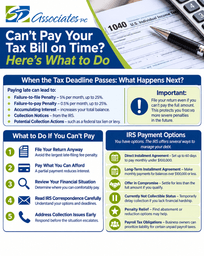
When the Tax Deadline Passes: What Happens Next?
What happens when you pay your tax bill late depends on how much you owe, how long the balance remains unpaid, and whether you filed your return on time. For most individual calendar-year taxpayers, April 15 is the regular filing and payment deadline.
If you request an extension, October 15 is generally the final deadline to file your return, but it doesn’t extend the time to pay taxes owed. Here are some potential consequences of paying a tax bill late:
- Failure-to-File Penalty — The IRS generally charges 5% of the unpaid tax for each month or partial month a return is late, up to 25%. This penalty applies when you fail to file by the applicable deadline, including an approved extension.
- Failure-to-Pay Penalty — The IRS generally charges 0.5% of the unpaid tax for each month or partial month the balance remains outstanding, up to 25%.
- Accumulating Interest — Interest accrues on unpaid taxes and applicable penalties, increasing your total balance over time.
- Collection Notices — You may receive letters requesting payment or explaining additional steps the IRS may take to collect your debt.
- Potential Collection Actions — If the balance remains unresolved, the IRS may eventually file a federal tax lien or levy eligible assets, subject to applicable procedures and taxpayer protections.
Important: The failure-to-file penalty and failure-to-pay penalty are separate. If both apply, the failure-to-file penalty is generally reduced by the failure-to-pay penalty during the same period. Nevertheless, filing late can be considerably more expensive than filing on time and arranging to pay the balance later. If you can’t afford your entire tax bill, file your return anyway.
How Different Tax Payment Situations Affect You
Not every late payment situation carries the same consequences. The following chart highlights common circumstances and what taxpayers should consider when deciding how to move forward:
| Tax Situation | Potential Consequences | Recommended Action |
| Filed on time but paid late | Interest and failure-to-pay penalties | Pay as much as possible immediately |
| Cannot pay the full balance | Growing balance and collection notices | Explore an IRS payment plan |
| Filed an extension but haven’t paid | Interest and penalties beginning from the original payment deadline | Make a payment and arrange to address the remaining balance |
| Failed to file and pay | Separate filing and payment penalties | File immediately and address the balance |
| Experiencing financial hardship | Potential difficulty meeting payment obligations | Request Currently Not Collectible status if eligible |
| Received an IRS collection notice | Possible escalation of collection activity | Respond promptly and seek guidance from SD Associates, P.C. |
What to Do If You Can’t Pay Your Tax Bill on Time
If you can’t pay your tax bill on time, taking a proactive approach can make a meaningful difference. Rather than waiting for another IRS notice, consider these steps to get your finances back on track:
- File Your Return Anyway — Submit your tax return by the applicable deadline, even if you can’t afford the balance. You will avoid the separate failure-to-file penalty, which generally accrues at a rate of 5% per month compared with the 0.5% monthly failure-to-pay penalty.
- Pay What You Can Afford — Make a partial payment using an available IRS payment method. Even a smaller payment reduces your outstanding principal and helps limit additional interest and penalties.
- Review Your Financial Situation — Examine your income, expenses, savings, and upcoming obligations to determine how much you can realistically contribute toward your tax debt. Having an accurate picture of your finances also helps you evaluate which IRS payment arrangements may be appropriate.
- Read IRS Correspondence Carefully — Review every notice to understand the amount you owe, applicable deadlines, and requested actions. Keep copies of letters, payment confirmations, and other relevant tax documents.
- Address Collection Issues Early — If you receive an IRS notice or believe collection action may be approaching, don’t ignore it. Responding promptly gives you an opportunity to understand your rights and explore available resolutions before the situation becomes more complicated.
IRS Payment Options That Can Make Tax Debt Manageable
The IRS offers several payment arrangements and penalty-relief programs to help individuals and businesses manage outstanding tax debt. The following chart outlines the eligibility requirements, benefits, and important considerations for each option.
| IRS Option | Eligibility / Requirements | Key Details |
| Short-Term Payment Plans | To apply online. Individuals who owe less than $100,000 in combined tax, penalties, and interest. | Provides up to 180 additional days to pay the balance in full. Generally, there is no setup fee, but interest and applicable penalties continue to accrue. |
| Long-Term Installment Agreements | To apply online. Individuals who owe $50,000 or less in combined tax, penalties, and interest and have filed all required returns. | Allows eligible taxpayers to make monthly payments. Setup fees may apply, and interest and penalties continue until the balance is paid. Different requirements apply to businesses and other taxpayers. |
| Offer in Compromise (OIC) | Taxpayers who qualify based on income, expenses, asset equity, and reasonable collection potential. | Allows qualifying taxpayers to settle certain tax debts for less than the full amount owed. Only 15.6% of offers resolved in fiscal year 2025 were accepted, according to the National Taxpayer Advocate. |
| Currently Not Collectible Status | Taxpayers who cannot pay their tax debt without sacrificing basic living expenses. | Temporarily delays IRS collection efforts. Financial documentation is required, and the IRS may periodically review eligibility. The debt remains, and interest and penalties generally continue accruing. |
| First-Time Penalty Abatement | Taxpayers with a qualifying compliance history who have filed required returns and paid or arranged to pay outstanding taxes. | May provide relief from certain failure-to-file, failure-to-pay, and failure-to-deposit penalties. The IRS is transitioning eligible taxpayers toward its Automatic Exemption from Penalty program, depending on the tax period. |
| Reasonable Cause Relief | Taxpayers whose inability to file or pay resulted from circumstances beyond their control despite exercising ordinary business care and prudence. | May eliminate certain penalties. Qualifying circumstances can include serious illness, natural disasters, or inability to obtain necessary records. Simply lacking money to pay generally isn’t sufficient. |
| Payroll Tax Obligations | Businesses and responsible individuals dealing with unpaid employee withholding taxes. | The Trust Fund Recovery Penalty can make responsible owners, officers, and other individuals personally liable for 100% of certain unpaid employee withholding taxes when they willfully fail to collect or pay them. Requires prompt professional attention. |

Frequently Asked Questions About Paying Your Tax Bill Late
Still have questions about what to do when you can’t pay your taxes by the deadline? Here are answers to a few common concerns:
What happens if I pay my taxes late but file my return on time?
You may face interest charges and a failure-to-pay penalty on your unpaid balance. The penalty is generally 0.5% of the unpaid tax per month, up to 25%. Paying as much as possible as soon as you can reduces additional costs.
Can I negotiate with the IRS if I cannot afford my tax bill?
Yes. Depending on your financial circumstances, you may qualify for an installment agreement, an Offer in Compromise, or temporary collection relief. However, each option has specific eligibility requirements, and the IRS carefully evaluates applications before approving them.
Will the IRS automatically give me an extension to pay my taxes?
No. An extension to file your tax return doesn’t extend the deadline for paying your taxes. For most individual calendar-year taxpayers, October 15 is the final filing deadline after an approved extension, but the payment deadline generally remains April 15. Any unpaid balance may continue accumulating interest and penalties after the original payment deadline.
Can the IRS remove penalties for paying my taxes late?
Possibly. Eligible taxpayers may qualify for first-time penalty abatement or reasonable cause relief, depending on their compliance history and circumstances. However, penalty relief isn’t automatic, and interest on unpaid taxes generally continues to accrue.
Can a tax professional help me resolve an unpaid tax balance?
Yes. An experienced CPA from SD Associates, P.C. can review your tax situation, explain available payment arrangements, evaluate penalty-relief opportunities, and help you communicate with the IRS to address outstanding obligations.
Get Expert Help Managing Your Tax Bill
Facing an unexpected tax bill doesn’t mean you’re out of options. Whether you’re dealing with a temporary financial setback, accumulated tax debt, or an IRS collection notice, taking action early can help you avoid unnecessary penalties and find a manageable path forward. The key is understanding your obligations, exploring available payment arrangements, and getting professional guidance before the situation becomes more complicated.
At SD Associates, P.C., our experienced tax professionals provide personalized tax preparation, planning, and dispute resolution services to individuals and businesses throughout the Philadelphia area. We can help you evaluate your tax liability, navigate IRS collection procedures, and determine which resolution strategies may be appropriate for your circumstances.
If you’re concerned about late tax bill payment or need assistance resolving an outstanding balance, explore our tax dispute resolution services to learn how we can help. Contact us today to schedule a free consultation and develop a strategy to move forward.

Navigation
Services
Accolades
